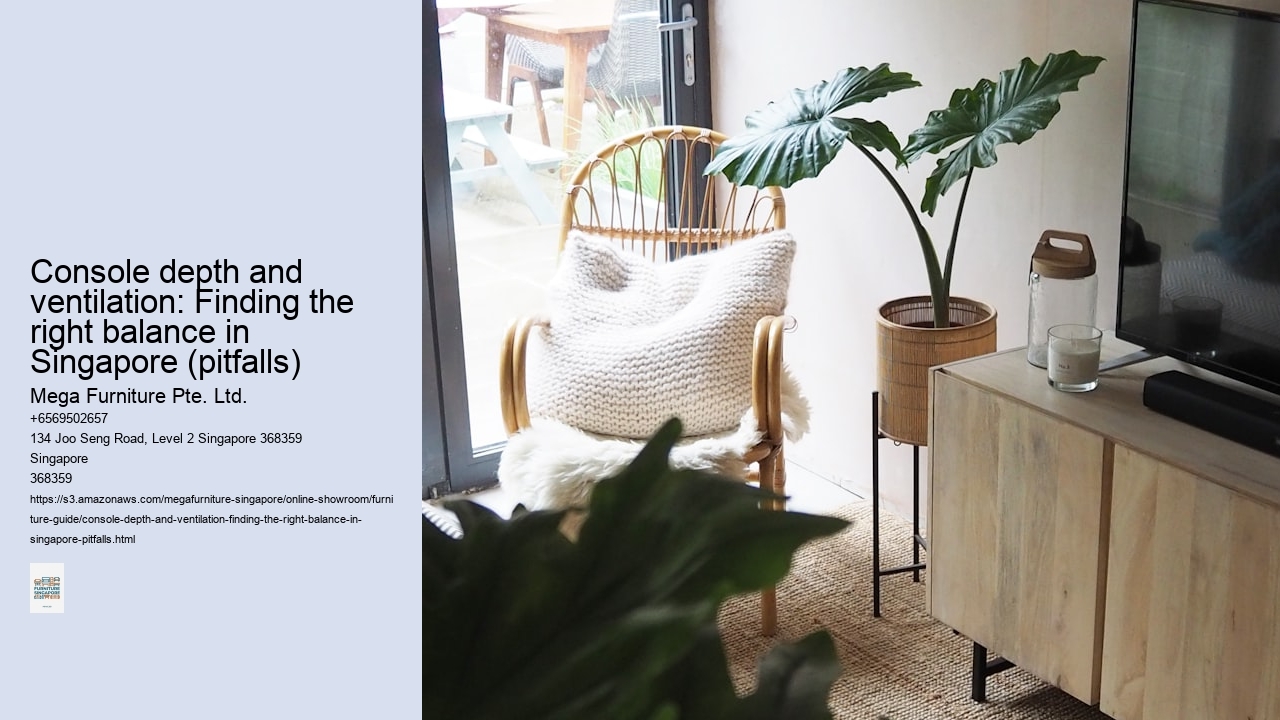
The back of a new TV console in a Tampines condo often tells you more about its lifespan than the front. It’s a silent, solid panel of wood or MDF, and that’s precisely the problem. In our climate, an enclosed cabinet becomes a heat box; an AV receiver or a PS5 left idling inside can push internal temperatures well past 40°C, which is a fast track to premature fan failure and component degradation. Humidity over 80% year-round doesn’t help, as it encourages condensation on cooler internal surfaces once the equipment powers down. That combination is brutal on electronics.
Consider the typical 4-room BTO living room layout, where the console is pushed flush against a feature wall. With a solid back panel, the only escape for that heat is forward, often getting trapped by tempered glass doors or simply recirculating in the confined space. The solution is non-negotiable: the back panel must be perforated or omitted entirely. Many modern designs feature a cable management system set within a fully open back, which is ideal. It allows the warm air generated by your media player and game console to dissipate naturally towards the wall cavity behind the unit.
Passive airflow is your best defence, and it relies on a simple principle: convection. Front mesh grilles, especially on cabinet doors intended for equipment, are essential—they allow cooler room air to be drawn in. Raised legs, even a modest 5cm clearance, create a crucial intake channel at the base. This setup lets hot air rise and exit through the open or perforated back, establishing a continuous cooling cycle without the need for noisy external fans. It’s a low-tech, utterly reliable system that Singapore’s climate demands.
Some buyers prioritise a seamless, built-in look and are tempted by consoles with fully enclosed boxes. That’s a compromise that usually ends with the console doors permanently ajar or the equipment relocated to an open shelf, defeating the purpose of concealed storage. A well-ventilated design shouldn’t be an afterthought; it’s the primary feature that protects an investment in home entertainment gear that can easily exceed $3,000. You can always add baskets for remotes or boxes for game discs, but you can’t retrofit a proper airflow system into a sealed box.
For those sourcing a new unit, it pays to examine product specifications and images closely for these details. Look for mentions of open backs, ventilation slats, or raised designs. Browse the options with a critical eye for these practical features, as they’re what will let your setup survive the relentless humidity.
Solid teak or oak consoles are a classic choice, but they’re a gamble in a 4-room BTO flat. Singapore’s humidity causes wood to swell and warp, especially around the Kallang basin or older estates like Bedok. That elegant shaker door you bought in December will likely be sticking by July’s monsoon season. The warping isn’t just cosmetic—it throws off alignment for drawer runners and can prevent doors from closing properly. You’re essentially paying for a material that fights the climate daily, and it usually loses.
Engineered wood with a melamine laminate facing is the pragmatic default for a reason. The cross-layered core resists the dimensional changes that plague solid timber, maintaining stability in compact living rooms where every millimetre counts. That moisture-resistant melamine skin is crucial; it stops spills from a plant or a drink from being absorbed instantly. You’ll find this construction handles the shift from your air-conditioned evenings to the daytime swamp outside far better. It’s a compromise on pure material prestige, but it’s one that guarantees the console’s shape lasts.
Plastic drawer glides feel cheap and they fail quickly, often jamming or snapping under the weight of game consoles and AV receivers. Full-length, side-mounted metal runners are non-negotiable for long-term use—they support the drawer’s entire weight and offer a smooth, quiet action. Check for models that specify steel or aluminium runners with a soft-close mechanism; that’s a clear signal the manufacturer prioritised durability over cutting corners. In a household where that drawer gets opened multiple times daily, this single component determines your long-term satisfaction more than the finish.
For families with toddlers or pets, a matte, textured finish is your best defence against the inevitable scuffs and scrapes. High-gloss laminates show every single mark, from a cat’s claw to a toy car being pushed across the surface, turning your centrepiece into a chronic eyesore. Opt for finishes described as ‘anti-fingerprint’ or with a structured grain; they’re typically more resilient and better at hiding minor abrasions. It’s a finish that acknowledges real life happens around the television, rather than pretending it doesn’t.
Those sharp, decorative edges on many contemporary designs are a liability in a tight space. A toddler running past or an adult squeezing between the console and sofa in a narrow layout will find them with their shin. Rounded or bevelled corners aren’t just a safety feature—they visually soften the piece’s footprint, making a 200cm console feel less imposing in a modest living room. It’s a subtle design cue that signals the piece was actually meant for living in, not just for looking at in a showroom.
A floating console mounted on a hollow partition wall looks clean, until it doesn’t. That sleek, leg-free design depends entirely on hitting solid structure behind the plasterboard — a gamble in many BTO layouts where non-load-bearing walls are common. The result of getting it wrong isn’t a slight tilt; it’s a catastrophic pull from the wall, taking your 75-inch TV and media gear with it. Proper installation requires a stud finder and, often, professional mounting to secure into the concrete column or beam behind. Another frequent misjudgement involves depth. Buyers measure for the console itself, then forget about the protruding plug points and HDMI ports on the wall. That leaves an unavoidable 15cm gap between the console back and the wall, creating a dust trap and a visible tangle of cables that defeats the purpose of a streamlined media wall. The solution is simple: factor in that extra few inches from the start, opting for a deeper unit or planning a false wall to fully conceal the services. Then there’s the alcove problem. Measuring just for the television, not the full built-in recess, is a classic error. You might end up with a console that overhangs the sides of a media wall niche, looking awkwardly crammed in, or one that’s too narrow, leaving wasted space on either side that collects clutter. In a 4-room BTO living room, where every centimetre of the feature wall is designed, this kind of misfit throws off the entire room’s balance. It’s a series of small oversights that add up to a permanent eyesore. The goal is a seamless integration where the console acts as a grounded base for the screen, not a piece that fights its surroundings. For those navigating these measurements, browsing the
floating TV console optionswith clear dimensions can provide a reliable starting point. Just remember to add those extra centimetres for the things you can’t see.
Online photos rarely show how a console’s laminate edge will catch the light in your living room, or how its doors sound when they close. That’s why a trip to a showroom, like Megafurniture’s at Joo Seng or Tampines, is decisive. You’re there to test the physical reality behind the marketing gloss—the true heft of the carcase, the precise action of the drawer glides, and whether that ‘oak’ finish looks convincing from two metres away. Bring your actual shopping list. A buyer wants storage for a PlayStation 5, a soundbar, and a media streamer, but product dimensions on a screen are just numbers. In the showroom, you can physically place a controller on a shelf, slide a console into a cubby, and see if the promised cable management holes align with your power strip. Singaporean setups are often dense; verifying clearances for a centre speaker or a router’s blinking lights prevents a costly mismatch. Ventilation is another critical check. Many consoles feature decorative cut-outs or mesh panels that suggest airflow, but they’re sometimes shallow or blocked by internal shelving. In a typical 4-room BTO living room, where ambient heat builds up quickly, functional ventilation isn’t a luxury. You need to peer inside, feel the depth of those openings, and confirm they’ll actually draw heat away from your electronics—not just look the part. You’ll also gauge stability. A 180cm console loaded with a 65-inch TV and AV gear demands a rigid frame. A gentle push at the showroom reveals any worrisome wobble or hollow-sounding panels that online specs can’t convey. It’s a simple test, but it separates furniture that lasts from pieces that feel insubstantial after a few months. Ultimately, the showroom visit shifts the decision from theoretical dimensions to lived experience. You leave knowing whether that sleek, floating design has enough hidden reinforcement, or if the smooth-gliding drawer will still feel that way in five years. For a central piece in your home, that confidence is worth the trip to
browse the optionsin person.
That oversized crate won’t fit past the lift lobby door. It’s a common scene in HDB blocks, where delivery crews wrestle with packaging designed for landed properties, not the 120cm-wide lift landings typical of many BTO flats. Console dimensions matter, but so does their shipping box — a 240cm unit might arrive in a crate exceeding 150cm, and that simply won’t turn the corner. Savvy buyers confirm door-to-door delivery includes unpacking at the kerb; the final journey to your 4-room flat should involve only the assembled piece or flat-pack cartons manageable in a lift.
Assembly, particularly for wall-mounted or floating consoles, is non-negotiable. Singapore’s walls are reinforced concrete, not plasterboard, and anchoring a unit loaded with a 75-inch TV and AV equipment demands a professional with the right drill bits and mounting hardware. A poorly secured unit is a safety hazard. While flat-pack assembly might seem straightforward, paying for professional installation ensures the console is perfectly level, securely anchored to the structural wall, and that any integrated cable management is properly organised — it’s a service worth the extra $80 to $150.
Warranties here need to read the room, literally. A standard one-year guarantee against manufacturing defects is almost useless in our climate. You need coverage that explicitly mentions humidity-related issues: swelling in solid wood panels, veneer delamination, or corrosion in drawer runners. Look for terms that cover ‘hardware failure’ under normal use, not just material faults; that’s what protects you when a soft-close hinge gives out after 18 months in your air-conditioned living room that still battles 70% humidity daily.
Some retailers bundle assembly with purchase, which simplifies things. For instance, Megafurniture’s collection offers professional installation, a sensible choice for wall-mounted units where precise mounting is critical. The real value, however, lies in the warranty fine print — it’s the difference between a company that understands furniture in the tropics and one that’s just shipping a product. Buyer wants a console that lasts five years, not one that warps after its first rainy season.
Can a 220cm console fit through a BTO main door? It’s a classic HDB dilemma. Standard BTO doors are often 90cm wide, but the frame and hinges eat into that clearance — you’ll need to measure the actual opening, not just the door leaf. For a piece that long, delivery teams typically tilt it vertically, navigating the narrow corridor from the lift lobby with practiced precision. If your unit’s on a high floor with a smaller service lift, that’s when the real negotiations begin.
What’s the ideal depth for a media wall with built-in lighting? Aim for 45 to 55cm. That depth accommodates most AV receivers and game consoles, while leaving a crucial 5–10cm gap at the back for cable routing and, more importantly, airflow. Built-in LED strips look slick but generate heat; without that rear buffer, you’re essentially baking your electronics inside a sintered stone or laminate box.
Managing cables for a floating console with no back panel requires a bit of deception. Use a combination of adhesive cable raceways mounted to the wall behind the unit and velcro straps to bundle wires into a single, neat trunk. The goal is to create the illusion the console is hovering, with all power cords and HDMI cables descending cleanly to the floor socket in one organised column — it’s a weekend project that pays off every time you don’t see a tangled mess.
Is a glass-top console practical with young children in a compact home? Frankly, it’s a high-maintenance choice. In a 4-room BTO living room, that glass surface becomes a magnet for sticky fingerprints, toy scratches, and constant anxiety. A textured laminate or a matte-finished sintered stone hides smudges better and withstands the occasional rogue racing car. If you’re set on the look, tempered safety glass is non-negotiable, but you’ll be reaching for the microfiber cloth more often than you’d like.
The moment you've measured your TV is the moment you should stop; that's when the real work begins, and it's all about the console you haven't bought yet. A common misstep is pairing a new 65-inch screen with a cabinet that looks like a shoebox underneath it, throwing the entire media wall off balance. For visual harmony, the console's length should sit between 1.2 and 1.5 times your TV's width—that proportion prevents the screen from appearing top-heavy and gives your soundbar or decor some breathing room on either side.
Depth is a practical trap, especially in a 4-room BTO layout where every centimetre counts. You can't just measure your PlayStation or AV receiver; you need to account for the tangle of HDMI and power cables snaking out the back. Verify the cabinet's internal depth accommodates your deepest component, then add a solid 5cm for cable management. Anything less, and you'll either leave the door ajar permanently or crush the connectors, a frustration you'll face every time you need to swap a device.
Material choice directly reflects your household's rhythm. A high-gloss acrylic or lacquered finish might look sleek in a showroom, but it'll show every fingerprint from a toddler's afternoon exploration or the dust from a ceiling fan in a week. Light oak or ash veneers bring a Scandi calm, yet they're prone to showing water rings from forgotten coasters and stains that seep in from spilled Ribena. For active families, a textured laminate or a darker, wire-brushed wood finish often weathers the daily chaos better, hiding smudges and minor scuffs between cleanings.
Finally, consider the unit's relationship to the floor. A floating console with legs creates an airy feel and makes robot vacuum runs easier, but it can also amplify cable clutter if not managed well. A full floor-standing design offers solidity and often more concealed storage, which is invaluable in a condo living room where clutter needs to disappear. It’s this last checklist run-through—measuring not just the space but your life in it—that turns a purchase from merely fitting to actually functioning.
The standard 4-room BTO living room is roughly 3.5 metres across. Plonk a 180-centimetre console in there, and you've just committed half your floor width to a single piece of furniture - that's the reality of scale in many HDB flats. It leaves just enough room to sidle past, forcing a careful dance between sofa depth, coffee table, and walking space. Buyers often underestimate this; they see a console's clean lines in a showroom and forget to measure their own corridor-like layout, where every centimetre dictates traffic flow and perceived spaciousness.
Condo media walls introduce a different, more precise constraint: depth. Floating consoles are a favourite for that sleek, built-in look, but their projection from the wall must be exact. Sideboard . A TV console anchors the wall opposite the sofa in the same way a tall bookshelf anchors a corner — long horizontal piece, mix of open and closed storage, defines the visual weight of one whole side of the room. Megafurniture's TV Console range covers floating wall-mounted designs, low-profile freestanding consoles, and modular feature-wall configurations. Most pieces sit at 40-50cm height, sized for screens up to 75 inches.. Too shallow, and your AV receiver or game console won't fit; too deep, and the unit starts jutting awkwardly into the room, negating the floating illusion. In many condos, the ideal depth is a tight 40 to 45 centimetres - enough to swallow a soundbar but not so much it becomes a shin-bruising hazard.
Then there's the television itself. Upgrade to a 65-inch or larger screen, and that 140cm console you bought five years ago suddenly looks like a tiny plinth under a massive painting. The proportions feel off, top-heavy and unstable even if the unit is perfectly sturdy. To avoid that unbalanced look on your feature wall, the console length needs to scale up. A good rule of thumb is for the console to be at least as wide as the TV, with many designers recommending a 200cm+ length for screens over 75 inches - it grounds the display and provides a more substantial visual anchor.
This push for proportion, however, runs headlong into Singapore's spatial limits. A 240cm console might be the perfect plinth for an 85-inch TV, but it simply won't fit on the wall between two BTO bedroom doors. That's where customisation or modular designs become essential, allowing you to tailor length and storage configuration to your specific wall and the equipment you need to hide. You can explore tailored solutions in Megafurniture's collection, which offers a range of lengths and styles to navigate these exact trade-offs.
Ultimately, choosing a console here is less about aesthetic preference and more about solving a spatial equation. It's a balancing act between the screen you want, the gear you own, and the walls you have to work with.
The standard 4-room BTO living room is roughly 3.5 metres across. Plonk a 180-centimetre console in there, and you’ve just committed half your floor width to a single piece of furniture — that’s the reality of scale in many HDB flats. It leaves just enough room to sidle past, forcing a careful dance between sofa depth, coffee table, and walking space. Buyers often underestimate this; they see a console’s clean lines in a showroom and forget to measure their own corridor-like layout, where every centimetre dictates traffic flow and perceived spaciousness.
Condo media walls introduce a different, more precise constraint: depth. Floating consoles are a favourite for that sleek, built-in look, but their projection from the wall must be exact. Too shallow, and your AV receiver or game console won’t fit; too deep, and the unit starts jutting awkwardly into the room, negating the floating illusion. In many condos, the ideal depth is a tight 40 to 45 centimetres — enough to swallow a soundbar but not so much it becomes a shin-bruising hazard.
Then there’s the television itself. Upgrade to a 65-inch or larger screen, and that 140cm console you bought five years ago suddenly looks like a tiny plinth under a massive painting. The proportions feel off, top-heavy and unstable even if the unit is perfectly sturdy. To avoid that unbalanced look on your feature wall, the console length needs to scale up. A good rule of thumb is for the console to be at least as wide as the TV, with many designers recommending a 200cm+ length for screens over 75 inches — it grounds the display and provides a more substantial visual anchor.
This push for proportion, however, runs headlong into Singapore’s spatial limits. A 240cm console might be the perfect plinth for an 85-inch TV, but it simply won’t fit on the wall between two BTO bedroom doors. That’s where customisation or modular designs become essential, allowing you to tailor length and storage configuration to your specific wall and the equipment you need to hide. You can explore tailored solutions in Megafurniture’s collection, which offers a range of lengths and styles to navigate these exact trade-offs.
Ultimately, choosing a console here is less about aesthetic preference and more about solving a spatial equation. It’s a balancing act between the screen you want, the gear you own, and the walls you have to work with.